


Your challenges, our solution
As an experienced partner to the automotive industry, we understand the key challenges involved in contacting battery cells:
- Major energy losses due to significant heat generation
- Rising production costs due to long cycle times
- Short service life of components due to harsh conditions
Our answer to this: the INGUN Battery Unit. A specialised team of experts that quickly and efficiently supports customers worldwide with tailor-made solutions. The result: faster formation processes, shorter test times, and noticeably lower energy consumption.

How much energy could you save?
Use a sample calculation to find out how much you could potentially save in your production.

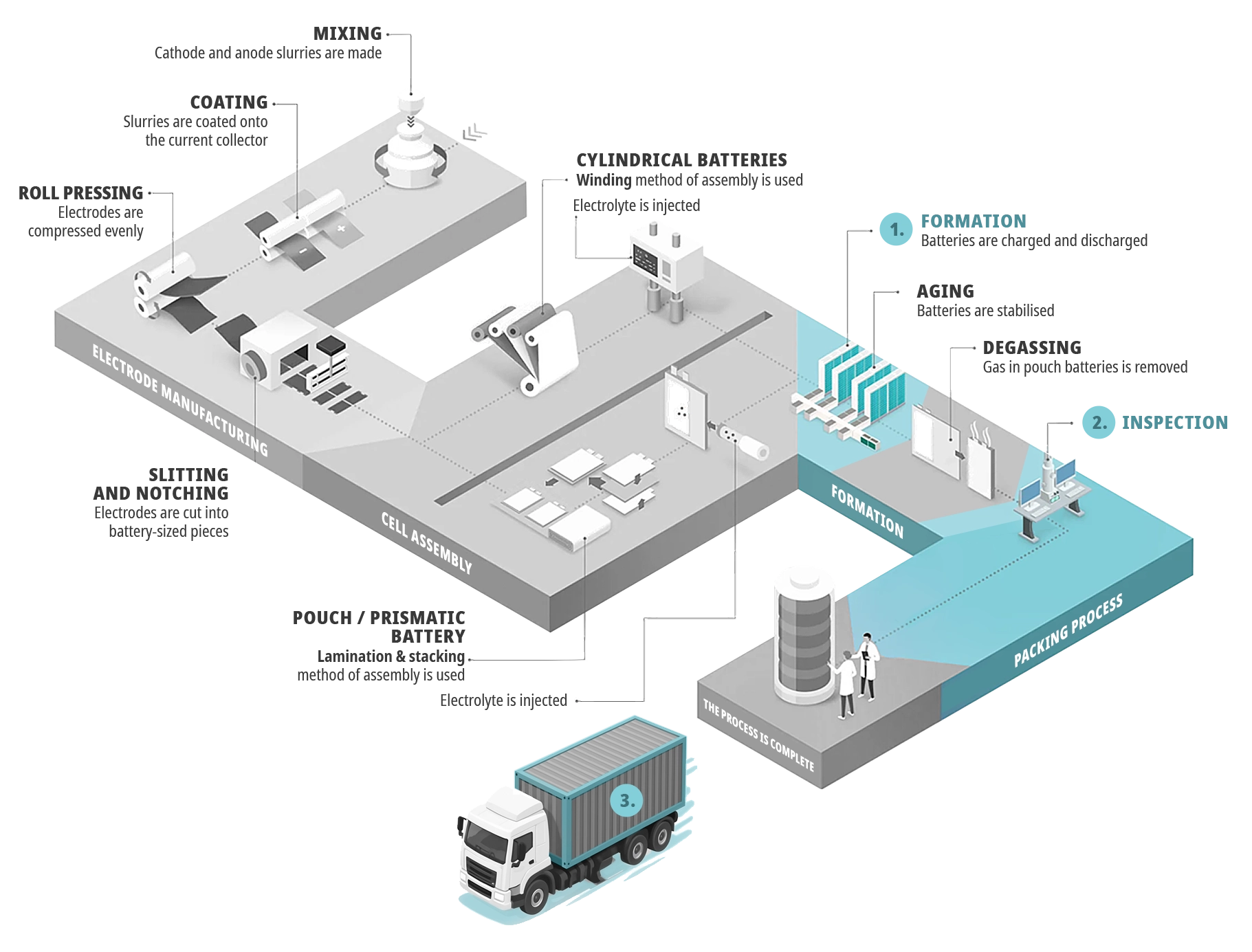
Formation is a crucial early step in cell production. This entails battery cells being charged and discharged for the first time, while parameters such as voltage curves, temperature behaviour, and capacity are monitored.
Our high-current probes are specially designed for this process step. Thanks to consistently low contact resistances, they ensure stable current transfer over thousands of cycles, ensuring efficient activation, minimal rejection rates, and consistently high cell quality.

End-of-line testing (EOL) takes place at the end of the production line. Here, battery cells are comprehensively tested for function and safety, including voltage, current behaviour, internal and insulation resistance, temperature behaviour, and communication with the battery management system.
Our modular solutions with robust probes are optimised for high-current and high-voltage applications. They boast high contact force, precise centring features, and long service life, which guarantee reliable results even under intensive repetition of test cycles.

After individual battery cells have been manufactured, they are assembled into modules and packs. Battery management systems (BMS) are a central component of these modules. They monitor the charge status of each individual cell and ensure that all cells remain in balance.
Our probes, which have been tried and tested millions of times in the field, are used for testing BMSs. Further information can be found in the PCB & Electronic Test section.
The finished battery modules are connected to loads via high-voltage connectors. Suitable test solutions for these interfaces can be found in the Connector Test section.

Formation is a crucial early step in cell production. This entails battery cells being charged and discharged for the first time, while parameters such as voltage curves, temperature behaviour, and capacity are monitored.
Our high-current probes are specially designed for this process step. Thanks to consistently low contact resistances, they ensure stable current transfer over thousands of cycles, ensuring efficient activation, minimal rejection rates, and consistently high cell quality.
End-of-line testing (EOL) takes place at the end of the production line. Here, battery cells are comprehensively tested for function and safety, including voltage, current behaviour, internal and insulation resistance, temperature behaviour, and communication with the battery management system.
Our modular solutions with robust probes are optimised for high-current and high-voltage applications. They boast high contact force, precise centring features, and long service life, which guarantee reliable results even under intensive repetition of test cycles.
After individual battery cells have been manufactured, they are assembled into modules and packs. Battery management systems (BMS) are a central component of these modules. They monitor the charge status of each individual cell and ensure that all cells remain in balance.
Our probes, which have been tried and tested millions of times in the field, are used for testing BMSs. Further information can be found in the PCB & Electronic Test section.
The finished battery modules are connected to loads via high-voltage connectors. Suitable test solutions for these interfaces can be found in the Connector Test section.
This is what sets our solution apart:
- Current carrying capacity: Up to 500 Amps
- Versatile applications: For pre-charge, formation, IR, OCV, and EOL tests
- Energy efficient: Low contact resistance for minimal energy loss and reduced heat loss
- Voltage measurement: Sense contacts guarantee precise measurement results
- Temperature monitoring: Optional feature with K-type, NTC, PT100 or PT1000 sensors
- Various installation methods: Press-in, screw-in, flange, or axle versions available
- Non-moving cable: Direct installation in busbars eliminates the need for cable installation
- Thermal management: Active or passive cooling during forming
- CleverCoat®: Patented palladium layer prevents tarnishing of probes


